



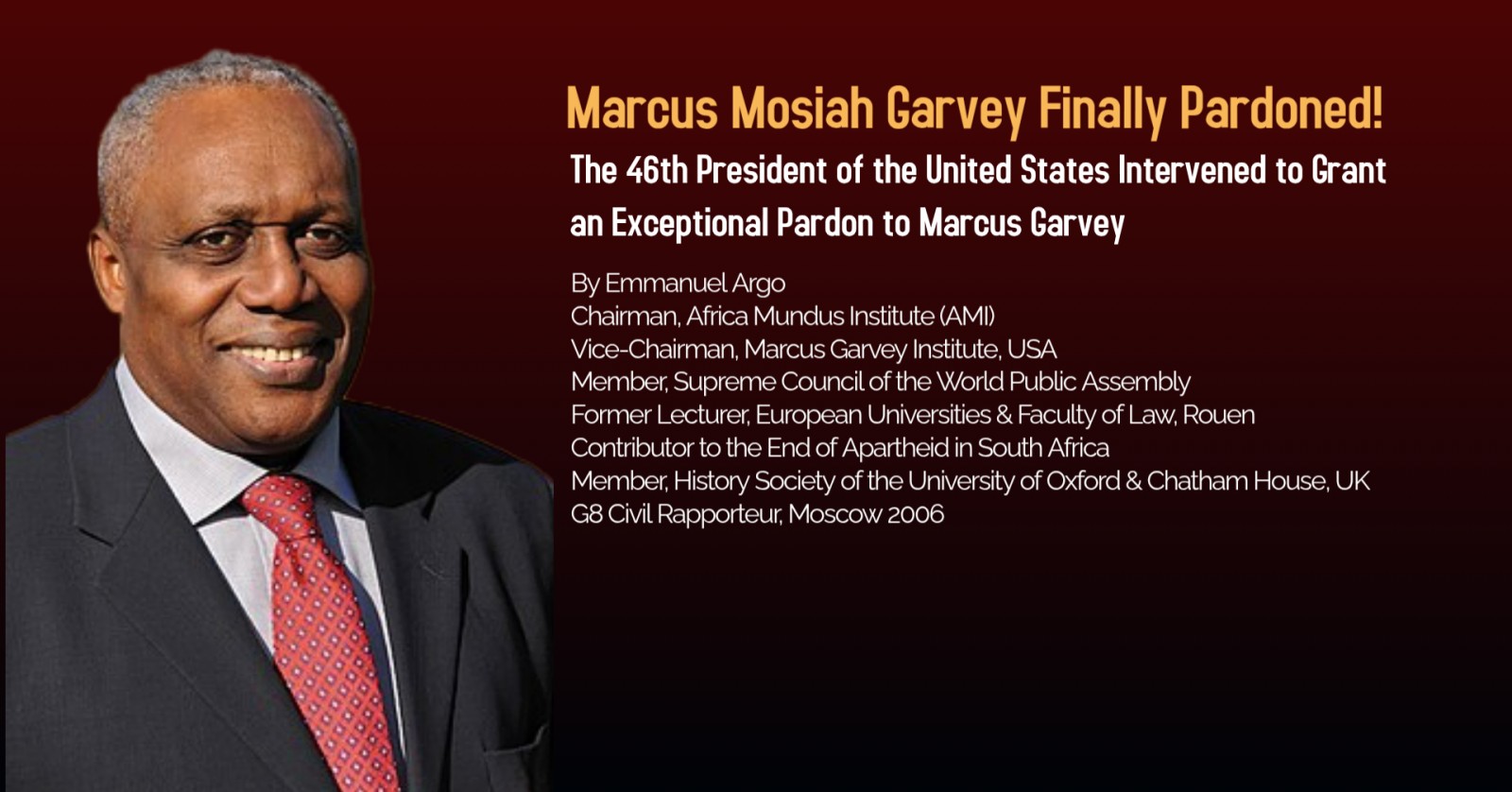
Marcus Mosiah Garvey Finally Pardoned!
- 18 janeiro, 2026
- 1295 views
The 46th President of the United States Intervened to Grant an Exceptional Pardon to Marcus Garvey
By Emmanuel Argo
- Chairman, Africa Mundus Institute (AMI)
- Vice-Chairman, Marcus Garvey Institute, USA
- Member, Supreme Council of the World Public Assembly
- Former Lecturer, European Universities & Faculty of Law, Rouen
- Contributor to the End of Apartheid in South Africa
- Member, History Society of the University of Oxford & Chatham House, UK
- G8 Civil Rapporteur, Moscow 2006
“There is no shame in ASKING.” This was the lesson my godmother Henriette often repeated to me in the 1950s, every Thursday, the weekly day off, when I accompanied her to the market in Martinique so that I could later navigate it alone and negotiate like her.
Before moving to Terres Sainville, we lived in the “Pont de Chaînes” neighborhood on the outskirts of Fort-de-France, the capital that succeeded Saint-Pierre, the former “Little Paris” of the Caribbean, destroyed in 1902 by the eruption of Mount Pelée. At that time, Fort-de-France was a bustling city, with streets still well-known today: Schœlcher, Blénac, Perrinon, Lamartine, Victor Hugo, among others.
The city’s commerce was diverse: clothing and fabric shops run by Syrian-Lebanese, Palestinian, and Franco-Israeli merchants, small Italian businesses in the outskirts, mid-sized stores owned by Martiniquais békés, and Afro-descendants active in electronics. Storefronts proudly displayed the owner’s name, signaling identity and craftsmanship.
Along the Baie des Flamands, the merchants’ circle gathered, exclusively male, around punch and the local sparkling water “Didier.” Neighborhood shops, run by Chinese and Afro-descendant families, sold fruits, vegetables, spices, meats, and traditional remedies. Markets for fish and local produce were lively, reflecting a culture of mutual assistance and civic respect.
Through these experiences, my godmother imparted a vital life lesson: asking is not a sign of weakness but of trust and solidarity.
It is in this spirit that, on the eve of President Joe Biden’s departure, I found it essential to request a pardon for Marcus Mosiah Garvey. Accused in the 1920s of fraud related to his shipping company, Black Star Line, Garvey was sentenced to five years in prison and banned from the United States. For seven decades, his family and civil rights organizations had appealed, without success, to Presidents Clinton, Obama, and Biden.
As Vice-Chairman of the Marcus Garvey Institute for Human Development in the USA, I proposed in January 2025 one final request for clemency. Despite skepticism from colleagues, Dean Julius Garvey, Marcus’s son, then 94, encouraged me. I personally addressed President Biden: “Mr. President, make one last effort to grant an in extremis pardon to the honorable Marcus Mosiah Garvey.”
Seven days later, on January 19, 2025, the Oval Office informed Dr. Julius Garvey that Marcus Garvey, second on the list, was among five new citizens granted clemency, in addition to 1,500 pardons in 2024.
I feel immense pride in having dared to ask, even as some claimed to be “more Pan-African than Garvey himself.” This boldness stems from two legacies: an upbringing rooted in benevolence and solidarity, and our Caribbean history, shaped by figures like Jacques Dessalines (Haiti), Marcus Garvey and his remarkable son Julius (Jamaica), Maryse Condé (Guadeloupe), and Frantz Fanon (Martinique), all descendants of enslaved Africans.
A more detailed account of this appeal and the concept of NegroEvolution, which I created and which aligns with Garvey’s Pan-African vision, will be published soon.
In a rapidly changing world, African diasporas must remain central partners and prepare realistic, non-violent solutions to protect the cultural and identity survival of our people, promoting initiatives like social and solidarity-based economies.
I extend my heartfelt thanks to Dr. Julius Garvey, Pierre Chaillan of L’Humanité, Honorary Haitian Ambassador Raymond Joseph, and his brother Léo Raymond, without whom my request would never have reached President Biden. Their efforts ensure that this historic decision is now part of Africa Mundus’ heritage.
Fort-de-France, January 9, 2026
- Categoria:
- Comunicado de imprensa
- Escrito por:
- Emmanuel Argo
- Sem comentários