
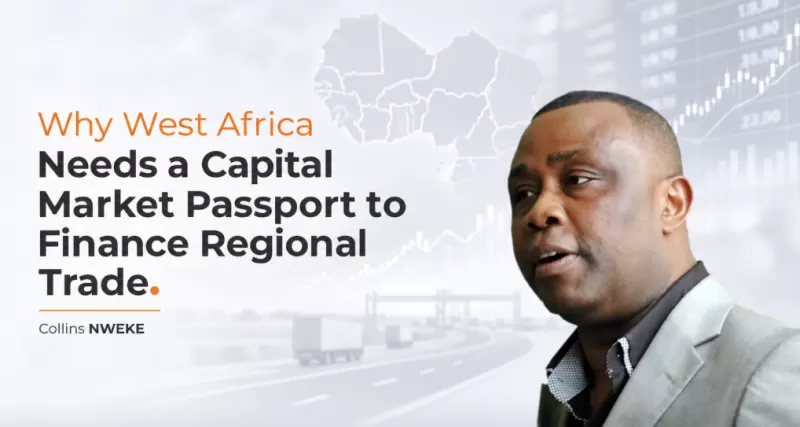
Collins Nweke, an international trade consultant across Nigeria, Belgium and Luxembourg, argues that West Africa is integrating its commerce while leaving its capital markets divided along national lines. His point of departure is the regional framework that Finance Minister Taiwo Oyedele presented at the S&P Global Ratings Africa Summit in Lagos on November 10, 2026, which proposes an issuer passport, a unified investor identity, connected trading and settlement systems, local-currency settlement, a regional bond index and a credit-enhancement facility for infrastructure.
Nweke tests the proposal against two recent transactions. The Dangote Petroleum Refinery IPO drew about N5.85 trillion in applications for an offer of 4.1 billion shares at N525 each, worth about N2.15 trillion, yet participation from other African markets required separate approvals, including a Global Depositary Receipt route approved by Kenya’s Capital Markets Authority. The Bakassi Deep Seaport, which broke ground on November 13, 2026, at an estimated cost of US$3.5 billion, shows financing needs that exceed the capacity of any single state or national market.
He supports a passport only as mutual recognition built on agreed minimum standards for disclosure, investor protection and enforcement, drawing on the European Union prospectus regime, and notes that local-currency settlement through PAPSS does not remove currency risk. He proposes a pilot with a limited group of issuers and institutional investors, credit enhancement reserved for properly prepared projects, and progress judged by completed transactions, with Belgium, Luxembourg and other European partners supporting an architecture that remains African-led.
In my work as an international trade consultant across Nigeria, Belgium and Luxembourg, I repeatedly encounter a familiar contradiction. West Africa speaks confidently about regional markets. Businesses are encouraged to think beyond national borders. Infrastructure is presented as regional, and trade corridors are designed to connect ports, producers and consumers across several countries. Yet the capital needed to finance these ambitions remains largely confined within national systems.
A company approved to raise capital in Nigeria cannot automatically offer securities to investors in Ghana, Côte d’Ivoire or Senegal. An investor already verified in one country may have to repeat onboarding procedures elsewhere. Transactions between neighbouring markets often depend on the US dollar, even when neither the issuer nor the investor is American. During a recent preparatory meeting, one of the business leaders joining my March 2027 Brussels Business Mission captured the contradiction neatly, observing that the region is attempting to integrate its commerce while leaving its financial architecture fragmented.
Nigeria’s Minister of Finance and Coordinating Minister of the Economy, Taiwo Oyedele, has proposed a more coherent approach. It includes a regional passport through which an issuer approved in one participating market could raise capital in others; a unified investor-identification system; connected trading and settlement infrastructure; local-currency settlement; a regional bond index; and a credit-enhancement facility for infrastructure. These are proposals, not yet an agreement among West African governments and regulators. But they address a real structural constraint.
Trade integration requires financial integration
The African Continental Free Trade Area is usually discussed in terms of tariffs, customs procedures, rules of origin and the movement of goods. These issues matter. But factories, ports, power plants, warehouses, railways and digital networks cannot be built with tariff schedules. They require capital.
A Nigerian manufacturer seeking to serve the wider West African market should be able to raise long-term finance from investors who also benefit from that regional market. A pension fund in Côte d’Ivoire should be able to consider a properly regulated Nigerian infrastructure bond. A Ghanaian investor should not face unnecessary regulatory duplication when investing in an eligible Senegalese or Nigerian enterprise. If goods are expected to cross borders but savings cannot, regional integration will remain structurally incomplete.
West Africa does not necessarily lack capital in absolute terms. Its pension funds, insurers, banks, investment funds, companies and households hold substantial financial resources. Much of that capital, however, is fragmented, concentrated in short-term instruments or absorbed by government borrowing. It does not move efficiently towards productive regional assets.
The Dangote transaction exposed the barrier
The Dangote refinery offer illustrated both the potential and the weakness of the present system. The initial public offer attracted orders close to N6 trillion, roughly three times the shares originally offered. Yet differing listing rules and separate regulatory approvals complicated efforts to widen participation across African exchanges. Kenya’s Capital Markets Authority approved a Global Depositary Receipt route, but the structure still required relevant Nigerian approvals. The technology for greater cross-border participation increasingly exists through initiatives such as the African Exchanges Linkage Project and the Pan-African Payment and Settlement System. The missing element is the regulatory and legal architecture needed to connect them.
Africa’s financial fragmentation is therefore no longer simply a technology problem. It is also a problem of regulatory trust. Will one country accept the due diligence conducted by another? Will investor identification be recognised across jurisdictions? What happens when an issuer defaults? Which courts have authority? How are taxes treated? Can an investor repatriate the proceeds? Who protects a minority shareholder when the issuer and investor operate under different legal systems? A regional passport must answer these questions.
Bakassi shows why scale matters
The groundbreaking of the proposed Bakassi Deep Seaport during the same week illustrates the scale of the financing challenge. The project is valued at approximately US$3.5 billion and is intended to provide an alternative maritime gateway, connect with a major highway and support trade extending beyond Cross River and Nigeria. The ceremony was an important execution milestone, but it did not by itself establish that the entire financing package had reached financial close. A project of this size cannot depend on the capacity of one state government or one national capital market.
Such projects require combinations of equity, development finance, long-term debt, guarantees and institutional investment. Some capital may come from outside Africa, as it should. But regional investors should also have credible routes to participate in assets that will shape their own trade and economic geography. A regional bond market could widen the investor base, while credit enhancement could improve a project’s risk profile. Local-currency instruments could reduce part of the foreign-exchange mismatch that has weakened many African projects.
The project itself must first be bankable. A regional market cannot rescue an incomplete feasibility study, unrealistic cargo projections or an unclear revenue model. Integration expands access to capital; it does not substitute for project preparation.
Local-currency settlement is strategically important
The proposal to settle regional securities transactions in local currencies deserves particular attention. West African economies routinely use scarce foreign exchange to intermediate transactions between neighbouring countries. This increases costs, introduces exchange-rate exposure and reinforces dependence on currencies outside the region.
PAPSS provides a foundation for reducing that dependence in trade payments. Extending compatible infrastructure into securities settlement could deepen its economic significance. But local-currency settlement does not eliminate currency risk. Investors still need confidence that markets are liquid, exchange rates are credible, and proceeds can be transferred lawfully. Capital-market integration will remain fragile without fiscal and monetary credibility in the participating states.
Integration must not become regulatory dilution
West Africa does not have to invent this principle from scratch. The proposed regional passport draws on a regulatory logic familiar within the European Union. Under the EU prospectus regime, a prospectus approved by the competent authority in one member state may be used to offer securities in other member states, subject to prescribed notification procedures.
Europe’s passport is not simply an agreement to trust whichever regulator acts first. It is supported by harmonised requirements governing disclosure, investor protection, market conduct, anti-money-laundering controls and securities settlement, together with mechanisms for cooperation among national regulators.
That distinction is critical. West Africa should borrow the architecture without pretending that regulatory equivalence already exists. A regional passport must mean mutual recognition after participating markets have agreed on credible minimum standards and demonstrated that they can enforce them. It cannot mean mutual recognition instead of standards.
The objective should be neither to export the weakest national rule across the region nor to impose the most cumbersome bureaucracy on every issuer. It should be to establish a common threshold strong enough to protect investors, preserve market integrity and give regulators confidence in one another’s decisions.
Europe should support without owning the architecture
Belgium, Luxembourg and the wider European Union can make a constructive contribution.
Luxembourg has extensive experience in cross-border funds, securities administration and regulatory coordination.
Belgium brings relevant banking, insurance, project-finance and infrastructure expertise.
European institutions can contribute guarantees, technical assistance and risk-sharing instruments.
That expertise could help West Africa design credible systems and prepare investable projects. But the architecture must remain African-led. The purpose is not to reproduce European systems mechanically or make African capital markets dependent on European intermediaries. It is to adapt useful experience to West African realities, including multiple currencies, different legal traditions and varying levels of market development. Partnership should strengthen African institutions, not displace them.
From proposal to implementation
The regional-passport proposal now needs a practical implementation pathway. Participating regulators should first agree on minimum disclosure, market-conduct and investor-protection standards. They should then identify a limited pilot group of issuers and institutional investors. Investor-identification systems must become interoperable, with strong data protection, while PAPSS and existing exchange-linkage infrastructure should be tested for securities settlement.
A regional credit-enhancement mechanism should support properly prepared infrastructure and industrial projects rather than general government expenditure. Taxation, insolvency and dispute-resolution rules must also be clarified before significant investor funds are committed. Success should be measured through completed transactions, namely capital raised, projects financed, settlement costs reduced and investors participating across borders.
A market worthy of the ambition
West Africa has spent years describing itself as a market of hundreds of millions of people. That demographic scale is real. But population alone does not create an integrated economy. Integration becomes meaningful when producers can sell regionally, infrastructure connects markets, payments clear efficiently and savings in one country can finance productive assets in another.
Nigeria’s proposal offers a serious foundation for that next stage. The region does not merely need more capital. It needs to organise the capital it already possesses, connect it across borders and protect those who commit it. West Africa cannot build a common economic future while its capital remains trapped in national silos.


التعليقات
جارٍ تحميل التعليقات…